文峰:西南财经大学财政税务学院副教授
吴堃:西南财经大学财政税务学院博士生
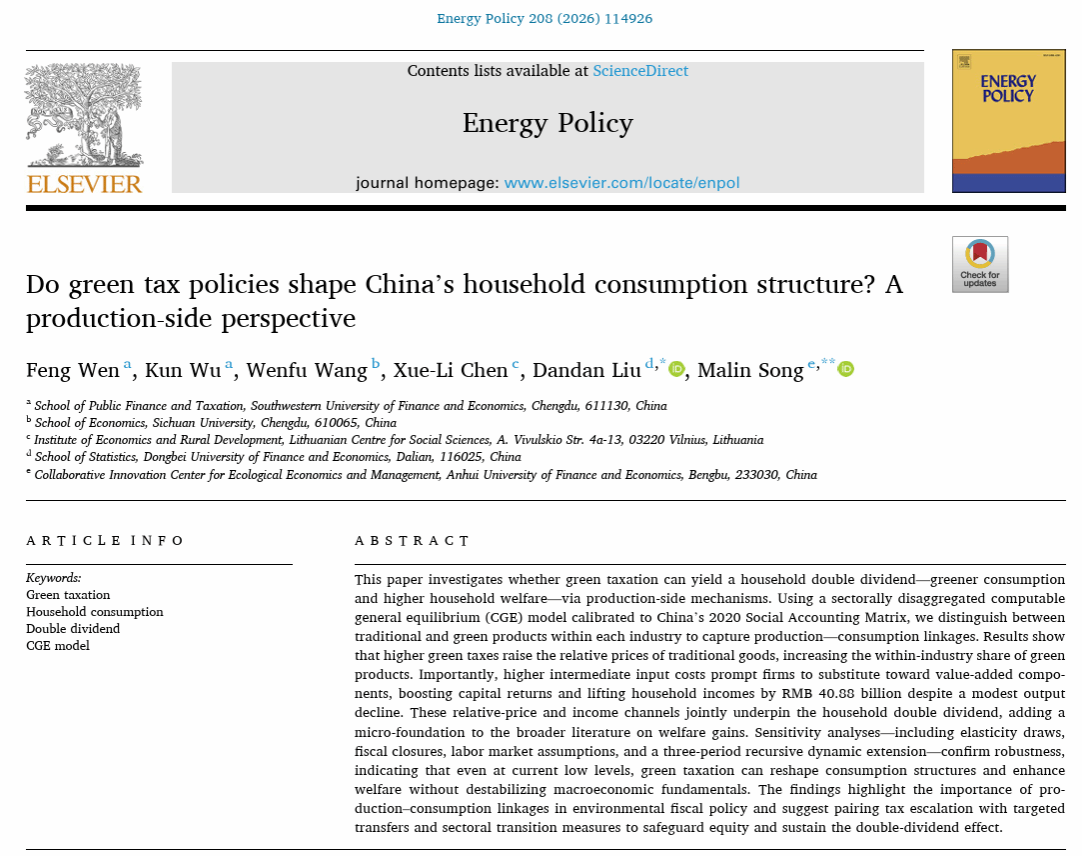
This paper investigates whether green taxation can yield a household double dividend—greener consumption and higher household welfare—via production-side mechanisms. Using a sectorally disaggregated computable general equilibrium (CGE) model calibrated to China's 2020 Social Accounting Matrix, we distinguish between traditional and green products within each industry to capture production—consumption linkages. Results show that higher green taxes raise the relative prices of traditional goods, increasing the within-industry share of green products. Importantly, higher intermediate input costs prompt firms to substitute toward value-added components, boosting capital returns and lifting household incomes by RMB 40.88 billion despite a modest output decline. These relative-price and income channels jointly underpin the household double dividend, adding a micro-foundation to the broader literature on welfare gains. Sensitivity analyses—including elasticity draws, fiscal closures, labor market assumptions, and a three-period recursive dynamic extension—confirm robustness, indicating that even at current low levels, green taxation can reshape consumption structures and enhance welfare without destabilizing macroeconomic fundamentals. The findings highlight the importance of production–consumption linkages in environmental fiscal policy and suggest pairing tax escalation with targeted transfers and sectoral transition measures to safeguard equity and sustain the double-dividend effect.
本文研究绿色税收能否通过生产端机制实现家庭双重红利——即更环保的消费与更高的家庭福利。我们采用基于中国2020年社会核算矩阵校准的行业分解可计算一般均衡(CGE)模型,区分各行业内的传统产品与绿色产品以捕捉生产-消费关联。结果显示,提高绿色税会推高传统商品的相对价格,从而提升绿色产品在行业内的占比。值得注意的是,中间投入成本上升促使企业转向高附加值组件,尽管产出略有下降,但资本回报率提升使家庭收入增加408.8亿元。这些相对价格与收入效应共同支撑了家庭双重红利,为更广泛的福利增益理论提供了微观基础。通过弹性曲线、财政紧缩、劳动力市场假设及三阶段递归动态扩展等敏感性分析,证实了该机制的稳健性,表明即使在当前低水平下,绿色税收也能重塑消费结构、提升福利而不动摇宏观经济基本面。研究结果凸显了生产-消费关联在环境财政政策中的重要性,并建议将税收递增与定向转移支付及行业转型措施相结合,以保障公平并维持双重红利效应。
资料来源:Wen, F., Wu, K., Wang, W., Chen, X. L., Liu, D., & Song, M. (2026). Do green tax policies shape China's household consumption structure? A production-side perspective. Energy Policy, 208, 114926.